Dead Canary: Hacksaw Gaming’s unconventional take on cluster payouts
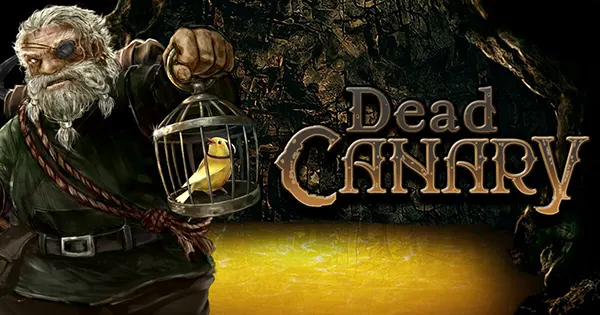
Dead Canary is one of those slot releases that clearly shows how far Hacksaw Gaming is willing to move away from familiar mechanics. Instead of relying on classic paylines or simple all-ways systems, the game builds its entire payout logic around clusters, volatility control and deliberately uneven symbol behaviour. By 2025 standards, this approach feels mature rather than experimental, reflecting the provider’s growing confidence in designing games for players who understand risk and mathematical structure.
Concept and positioning of Dead Canary
Dead Canary was designed as a medium-to-high volatility slot that focuses on sustained engagement rather than constant small wins. Hacksaw Gaming positioned it for players who appreciate deliberate pacing, where rounds without payouts are part of the experience rather than a flaw. This design choice aligns with the studio’s broader portfolio, which increasingly favours defined mathematical identity over mass appeal.
The visual theme supports this concept by avoiding excessive animation and distraction. Instead, the game uses restrained graphics and a muted colour palette to keep attention on symbol behaviour and grid development. This reinforces the idea that Dead Canary is primarily about mechanics, not spectacle.
From a market perspective, the slot fits well into the post-2024 trend of “thinking-player” releases. Many studios now acknowledge that a significant part of the audience actively compares RTP distribution, hit frequency and bonus impact, and Dead Canary clearly targets that segment.
Why cluster payouts suit this game model
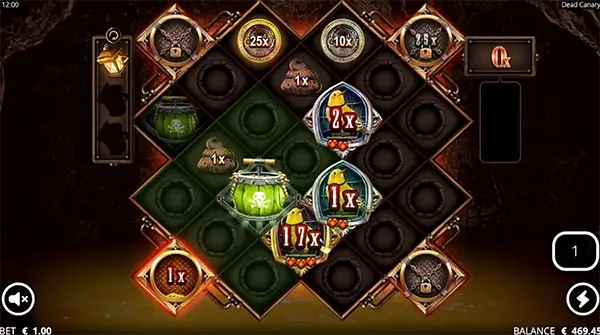
Cluster payouts allow Hacksaw Gaming to move away from predictable line-based results. In Dead Canary, wins are formed by groups of identical symbols touching horizontally or vertically, which creates irregular win shapes and more varied outcomes. This structure gives developers greater freedom in balancing volatility.
Unlike traditional systems, cluster mechanics reduce the sense of artificial limitation. Wins do not feel constrained by invisible lines, which helps players intuitively understand why a result occurred. Over time, this transparency builds trust in the game’s logic.
In Dead Canary, cluster payouts also enable chain reactions. When winning symbols disappear, new ones fall into place, potentially creating additional clusters. This cascading behaviour adds depth without relying on overly complex bonus rules.
How the cluster payout system works in practice
The core grid in Dead Canary is structured to maximise symbol interaction. Rather than filling every reel with uniform probability, the game uses weighted symbol distribution. This means some symbols appear frequently to maintain momentum, while others are deliberately scarce to preserve payout tension.
Clusters require a minimum number of matching symbols to trigger a win, typically four or more. Once a cluster pays, it is removed, and the grid refills. This process can repeat multiple times in a single spin, creating layered results that feel earned rather than random.
Importantly, the payout values are scaled carefully. Small clusters provide modest returns, while larger formations increase rewards exponentially. This ensures that rare grid-wide events remain meaningful without distorting overall RTP.
Cascading mechanics and volatility control
Cascades are not guaranteed in every spin, which is a conscious design decision. Hacksaw Gaming uses this limitation to manage volatility, ensuring that long cascade chains remain special. When they occur, they can significantly shift the session balance.
The absence of forced cascades prevents the game from feeling overly generous. Players quickly learn that each additional cascade is statistically valuable, reinforcing patience and strategic bankroll management.
This approach reflects modern slot design principles, where volatility is shaped through probability layers rather than surface-level features. Dead Canary exemplifies this philosophy with clarity.
Bonus structure and interaction with clusters
The bonus mechanics in Dead Canary are intentionally restrained. Instead of introducing separate mini-games, the slot enhances its base cluster system through modifiers. These may include expanding symbols, temporary multipliers or altered gravity behaviour on the grid.
Such bonuses do not replace the core mechanic but amplify it. This keeps learning curves low while still providing meaningful variation during longer sessions. Players who understand the base game are rewarded for that understanding.
From a technical standpoint, this design reduces the risk of bonus fatigue. Each feature feels like an extension of the main game rather than an interruption.
Multipliers and risk amplification
Multipliers in Dead Canary are applied selectively, often tied to cascade depth or specific symbol interactions. This ensures that higher rewards are always connected to higher risk, maintaining mathematical consistency.
Unlike fixed multipliers, these values can stack during a single spin. While rare, such events create memorable moments without undermining long-term balance.
For experienced players, this structure offers a clear risk-reward relationship. There are no hidden shortcuts to large wins, only statistically justified outcomes.